
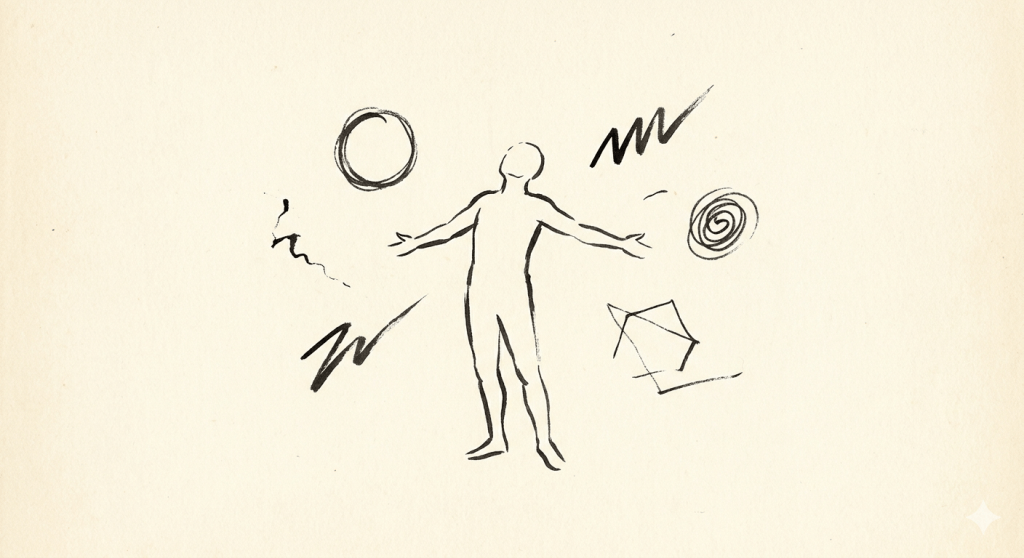
I always wished to live a creative life without any rules. What that life means is a concept I want to explore because within the constraints of rules, regulation and limits, genius dies. What I consider “genius” are the creations that show up when nothing defines who the creator must be, what directions they are to follow, or what their creation must look like. I believe in creation at a childlike level, with all the care and quality a grown person can bring to delivery. I believe in that creation being made by someone curious, experimental, unaware of “perfection” and just living, the way a child always does. Most art, most performance, most creativity is done with survival in mind. We care so much about appearing better than the next person that we forget why we were made to create in the first place.
We have been primed to care about survival. We need money. We need status. We need the basics that make us human. And we care now, more than ever, about securing those basics that we have numbed out the carefree parts of ourselves and pruned them away to be as efficient as possible in the hunt for resources. Yet the innovators we look up to all had a beginner’s mindset. They were versatile. They got the most value out of what they made and out of this life. We try to control so much that the friction between idea and execution has never been higher. Control breeds procrastination. Procrastination is the thief of time and, ultimately, of life itself. Control makes us byproducts of someone else’s vision, and our creations drift so far from the original that they rob both us and our audiences of raw, unfiltered first impressions.
Creating without control is easy. Easy because there is no judgement. No comparison. When originality and authenticity get room to breathe, the “one in eight billion” in us comes out. We transcend the judge’s sheet. Who we are becomes the only thing that defines our work. What that work is “supposed” to be stops being guided by anything other than its truest natural form. This is what living without limits actually means. We live without limits when we know nothing, because knowing nothing means there are no definitions, no boxes to be in, nothing to think outside of. Only then do we get genuine expressive freedom. Only then do our thought processes take any shape, form or color that is actually ours.
To be deadly serious but playfully alive, you need a mindset that puts you at the heart of creation while keeping you alive in the truest sense. This is where the beginner’s mind comes in. I loved reading The Creative Act by Rick Rubin. On the beginner’s mind, he writes that experience provides wisdom to draw from, but it tempers the power of naivete. That’s the whole point. Our systems are built on records of history. They are optimized. And that optimization is exactly what strips away the innocence we could use to engage freely with whatever is in front of us. The beginner’s, childlike mindset gives us radical honesty, freedom and creativity at levels where fear disappears, not because we’ve conquered it, but because we’re so absorbed in creation that we forget it was ever there.
There are two groups of people who operate at maximum creativity. Both have something in common: neither is guided by social standards. 98% of five-year-olds test at the creative genius level. By age 10 that number drops to 30%. By 15, it’s 13%. By adulthood, only 2% of us test there. Yet we all assume we are somewhat creative. Our younger, more naive selves would probably do a better job at expressing themselves than our most educated, most experienced versions can. This is because creativity is everything we spend our adult lives trying to avoid. It is trying, making mistakes, and learning. It is not linear. It is messy. Creativity is also simple. It is making stuff out of other stuff. Life gives us coloring books. The choice is whether we color within the lines or in whatever way makes us and our audiences feel something real.
The second group is the granny does graffiti group. Older adults who doodle, paint and mess around with no criteria to be judged on, they nearly mirror the creativity of five-year-olds. Because they too have let go of judgement. For them, showing up to create becomes something to look forward to every single day. Everything they have ever seen, felt and lived gets folded back into the work. Their creativity is known to make them less depressed and less anxious. Not a prescription, not a diagnosis, just the act of making things without caring what the result looks like.
Here’s what I think those two groups understand that the rest of us have forgotten: artistry and creativity are not the same thing. Artistry is the performance of skill. Creativity is something you were born with and slowly, systematically, got talked out of. The survival game we play as adults trains us to do things we already know will work, in ways that will be validated, toward outcomes that are legible to other people. But the most alive you will ever feel in a creative act is the moment you are doing something outside of all of that; outside the course, outside validation, outside any reward beyond the act itself. What goes in is the result.
The only real barrier is starting before you’re sure you want to. You don’t want to do something before you know you want to do it. But that moment of certainty, that feeling of readiness, is another form of control. Another version of waiting for permission from yourself. The five-year-old doesn’t wait. The granny doesn’t wait. They just begin.
Be deadly serious about that. And then play


Leave a comment