
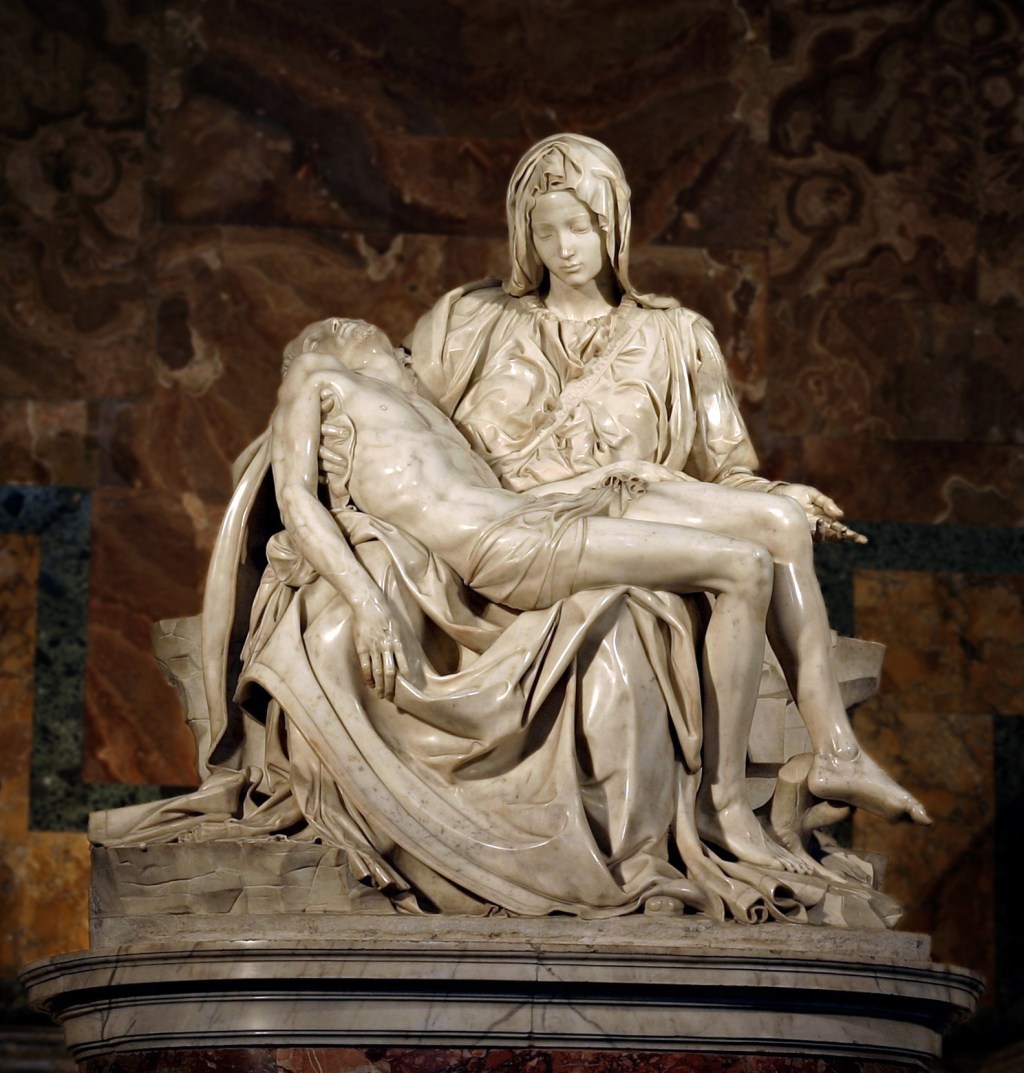
One of the most intricate bonds in human life is the relationship between a mother and her son. When it finds the right chemistry, it becomes unbreakable. Mothers are often the first shields against chaos, their presence a barrier no storm can easily penetrate. They are guided by instincts that border on the supernatural, seeing danger and possibility even in silence. Yet every bond has limits. Where do the boundaries of this relationship lie? When does a mother’s love, protective and tender, have to give way to something greater?
There comes a time when every mother must become Mary. She must watch her son walk toward a purpose that will not spare him from pain. To stay sheltered would preserve the body but stunt the soul. To step into the world means risking wounds and betrayals, yet on the other side lies transformation: the soul of a warrior and the body of a champion.
Biologically, the relationship begins at birth, though its roots stretch into the months before. Mothers make sacrifices from the moment they choose to protect the life within them, refusing what might harm the child who depends entirely on them. At the moment of delivery, when the newborn is placed into her arms, the bond feels less like a medical procedure and more like an initiation rite, a covenant sealed in touch, as if mother and child enter into a synchrony older than memory itself.
But almost instantly, the first crucifixion occurs. The child is taken away, clothed, and placed among strangers. It is a small rupture, yet it foreshadows the rhythm of life: every closeness will one day demand a letting go. In that moment, the mother endures what all future partings will echo. She learns that to love deeply is also to let go, even when every instinct demands to hold on.
From there, she tends to her child with unrelenting care. Much of early socialization flows through her hands and her voice, shaping not only the home but the child’s first sense of the world itself. For years, our choices are measured against our mothers’ gaze. Even in her absence, her presence governs us; we restrain ourselves not from fear but from the weight of her imagined disappointment. She puts aside her ambitions so we can grow into ours, stepping back so we may step forward.
This chapter of life is written less in conscious memory and more in feeling. We often cannot recall the details, yet mothers remember, because while we have known them only for as long as we have been alive, they have known us for the entirety of our existence. That asymmetry is the bridge. They become our first friends, our first protectors, our first mirrors. And perhaps it is precisely that bridge which makes letting go so difficult.
There is the system, and with the way it is built, mothers must let go of their sons again. The first great surrender is to education. School has become the cornerstone of modern life, and the moment a child walks into that space, a mother releases him into the care of others. But this release is not to an impersonal machine. It is to other mothers. Excluding post-secondary institutions, three out of four teachers are women, and they carry within them some maternal instinct. In a sense, they become guardians of her son for a time, acting as mothers of some sense.
This handing over mirrors the road to Calvary. Mary could not stop the journey, but others stepped in briefly to ease it. When Veronica broke through the crowd to wipe the blood and sweat from Jesus’ face, it was not an act of rebellion against Mary’s love but an extension of it. She too, just like the other mothers in our lives, carried the motherly impulse to protect, to comfort, to serve, even when she was not His mother. So it is with education. The biological mother releases her son into a battle for grades, accolades, friendships, and recognition, and in the process he finds himself under the care of new mother figures who also want to see him thrive.
At home he was the legend who fixed the TV by changing the HDMI connection from port 1 to port 2. At school, the demands are far greater, and the tests unrelenting. For the mother, this is both terrifying and necessary. She sends him out each morning into the unknown, not because she is certain of the outcome but because she believes his purpose is larger than her comfort.
This surrender exposes the child to the scrutiny of the world. Here again the parallel is striking. When Jesus stood questioned in public, those who truly knew Him had to endure the sight of strangers reducing Him to accusations, dismissals, and ridicule. Mothers know this anguish. They know the boy better than anyone, yet they must watch him face trials set by people who cannot see him as he truly is. And they cannot intervene. They can only bear witness.
Every stage of growth brings these small crucifixions. Our reasons for being become more important than the things we have already mastered, and in pursuit of that higher calling, we are bound to stumble. Mothers, uncertain but steadfast, must endure the helplessness of watching their sons fight battles they cannot fight for them. Sometimes they can’t even tend to the wounds. They must let their children heal alone, trusting that in the struggle, purpose is being forged.
There are people and places that have cared for us, and then had to let us go, no matter how much it pained them, or us. These too are our mothers. I remember starting off secondary school at Kutama College, convinced I would spend all my years there. The vision I shared with the institution felt permanent, and the pursuit of excellence within that single space consumed me. It was a happy home, a place where I felt known, affirmed and validated. Yet at a certain point, an opportunity opened my eyes to a larger world. To step into it, I had to release what had once seemed eternal. The security of the familiar was no longer enough. What I thought was a final destination revealed itself as a stepping stone, and so when I told all my teachers and peers i wasn’t returning, it almost felt like I was reducing myself to a nobody again.
It is the high of Jesus entering Jerusalem. The city received Him in triumph, crowds spreading palm branches before His path, acclaiming Him as King. Yet the high of that welcome was not the climax. It was only the end of one chapter. Soon after, He would pray in Gethsemane, aware that the path ahead held betrayal, humiliation, and a public execution of unspeakable cruelty. The contrast could not be starker: celebration followed by surrender. Stepping stones are fundamentally the same in essence. They give us moments of pure happiness, but those moments are not always the final reward. They are preludes to the greater challenges that shape who we are, because sometimes we don’t get shaped into becoming something, we are meant to shed off some parts to reveal others.
The places and people who mentor us, who believe in us, who push us toward more, are acting as mothers. They nurture, they protect, they prepare. Yet when the breaking point arrives, they too must release us. They must know their role was never to be permanent but to equip us for what lies beyond. And for the son, the choice is the same as it was on the first day of life: to stay within comfort, or to let go and pursue a higher purpose, even when the battles ahead remain unknown. It is this tension, between what loves us and what calls us, that makes the journey not only difficult but profoundly worth taking.
Mostly, the people in support of us are the midwives of potential. We are bound to them for some time, then we are meant to move on. When we let go, we throw ourselves into worlds we don’t know much about, yet we forge our legacies in them. Only when we are let go can we be able to be uncomfortable enough to be greater than our greatest yesterdays.
The sun watches us as it departs, and then it leaves us to the frightening hours of night. In that darkness lie our deepest fears and insecurities, the questions we cannot silence, the wounds that ache when all else is still. Yet the night is not wasted. It is in the dark that we wrestle with ourselves, that we learn to endure, that we have the long and honest conversations with our own souls. We fight battles no one else sees, hoping that when the sun rises again, it will find us changed, strengthened, ready to live another day.
The sun, even in absence, does not vanish. It continues to shine for another part of the world. It keeps being the sun. In the same way, our mothers never stop being mothers, even when we are left in the dark. Some of us do not make it through the night. Some falter under the weight of fear. But for those who keep working in the shadows, dawn always comes, and with it, the return of the motherly warmth that never truly left.
This is Jesus looking down at Mary and John at the cross. Jesus looked upon Mary and entrusted her to John, and John to Mary. It was a dark transfer, a moment where the son was taken from her and given to another. For three days, she lived in absence. For three days, her son was beyond her reach, in a place she could not enter or control. Yet even there, her role did not vanish. She became a mother to John, carrying forward her vocation to nurture while the night held her own child.
When she saw Him again, He was transformed. Death had been conquered. The mission was complete. Her grief had been the price of glory, her surrender the soil in which resurrection bloomed. In this she proved not only why she was chosen to bear Him, but why she remains a model of motherhood itself.
The night is long, the pain often unbearable, but the sun always returns. Our mothers always return. And when they do, they find us changed. They find us closer to our mission, closer to the selves we were meant to become. The crucifixion is not the end. It is the passage through darkness toward the dawn of purpose fulfilled.

 Tadiwa Vambe
Leave a comment